

Robotic pit stops for driverless fleets · London first
Charge, clean and inspect robotaxis in the city, in one stop
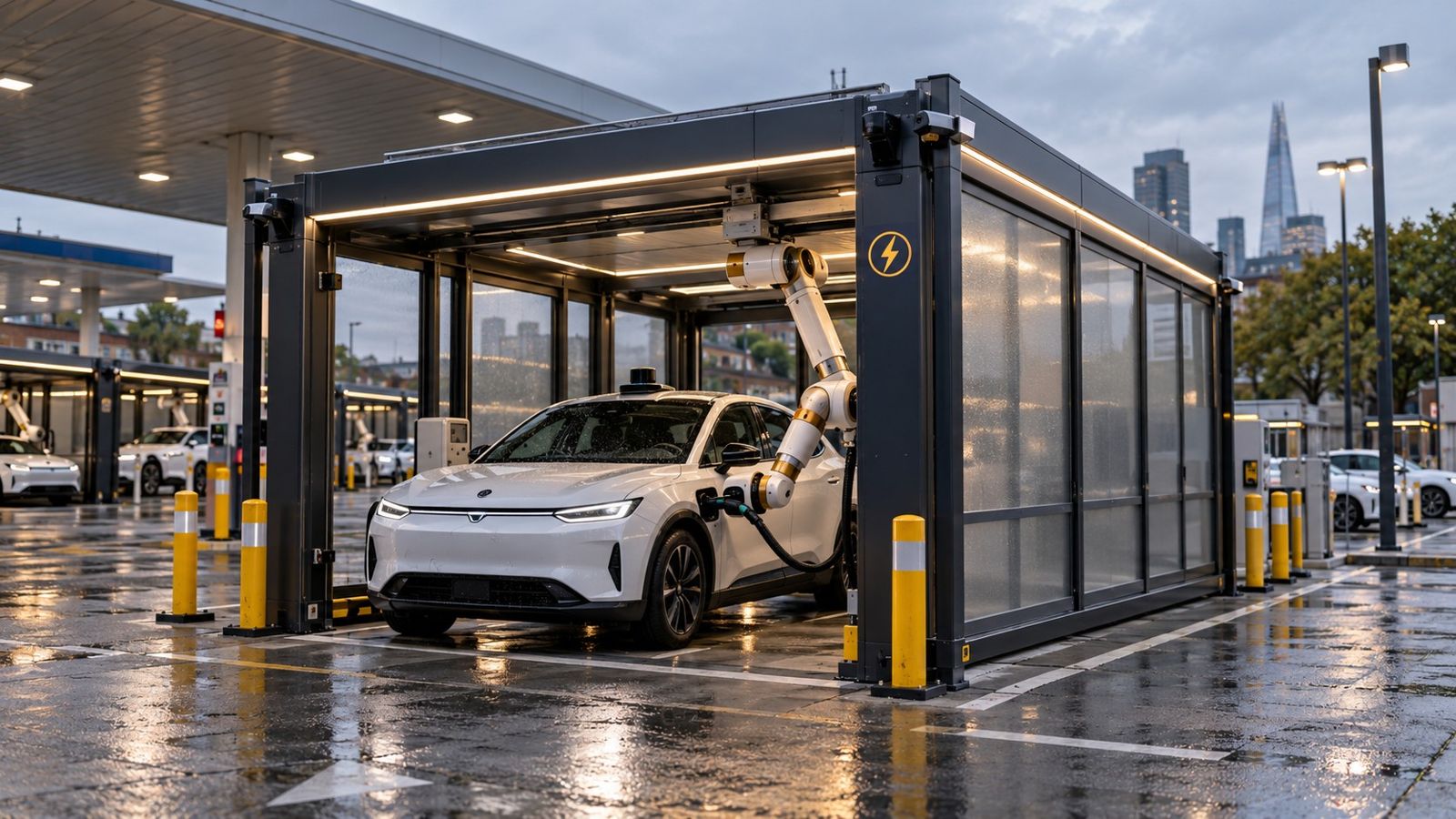
Autonode is building Europe’s first network of robotic pit-stop pods: compact hubs, about the size of two parking bays, that keep autonomous fleets on the road close to their riders instead of driving empty to out-of-town depots.
The problem
Empty miles to distant depots eat the margin
Robotaxis drive themselves, but charging, cleaning and checking them is still done by people in depots on the edge of town.
charges per vehicle per day in a busy robotaxi fleet
Electrek, April 2026empty miles per vehicle per day driving to out-of-town depots
RobotaxiON, industry estimatecharging labour and overhead per depot per year today
RoboDock (Y Combinator)Cleaning is still manual. Every dirty cabin takes a car off the road until a person fixes it.
Europe makes it harder. Historic centres, scarce land and high rents push depots to the edge of town, so every charge or clean means a long empty drive.
How it works
One pit stop, six steps, under 20 minutes
The fleet books a slot, the car drives in on its own, and the pod charges, scans and cleans it at the same time. Each step has its own AI model.
- 1
Arrive
The fleet books the pod; the car drives in on its own.
Dispatch AI - 2
Scan
Cameras check the body, tyres and cabin.
Inspection AI - 3
Charge
A robot arm plugs in; the top-up is sized to demand.
Vision-guided arm - 4
Clean
The cabin is reset while the car charges.
Clean-or-escalate AI - 5
Sensor wash
Lidar and cameras are cleaned.
Sensor-health AI - 6
Release
The car rejoins service in its operating zone.
Dispatch AI
It knows its limits. Anything the robots should not attempt, such as a bad spill or damage, is flagged, and the car goes to the operator’s depot for a person to handle. A certified safety controller, separate from the AI, can always stop the robots.
Inside the pod
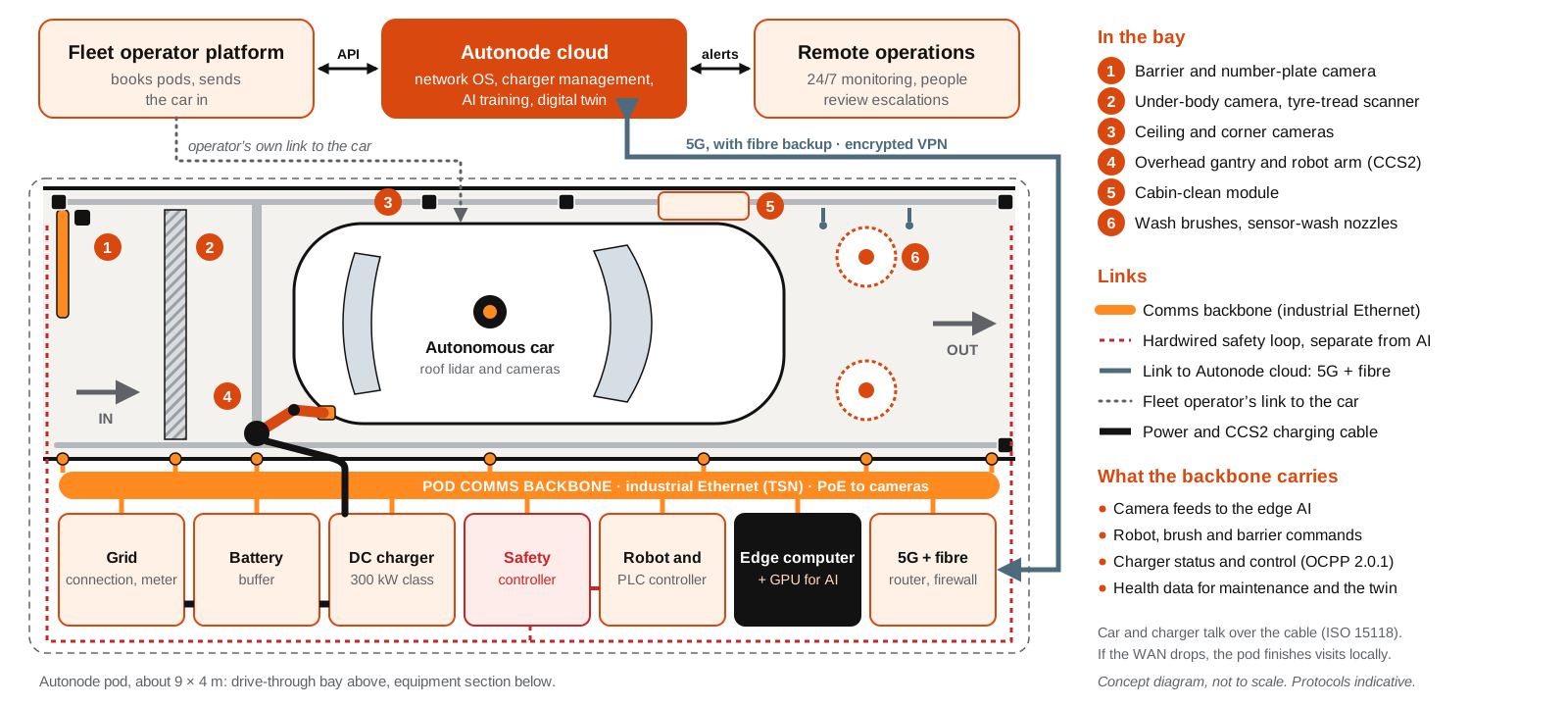
A drive-through bay plus an equipment section, about 9 × 4 m. Proven, bought-in hardware, joined by one comms backbone and run by our pod software.
- Overhead gantry and robot arm (CCS2 connector)
- Ceiling, corner and under-body cameras
- Wash brushes, sensor-wash nozzles and a cabin-clean module
- DC fast charger and battery buffer to ease grid limits
- Edge computer for on-site AI, linked to the cloud over 5G and fibre
The charger is chosen by open tender among 300 kW-class suppliers.
Where pods go
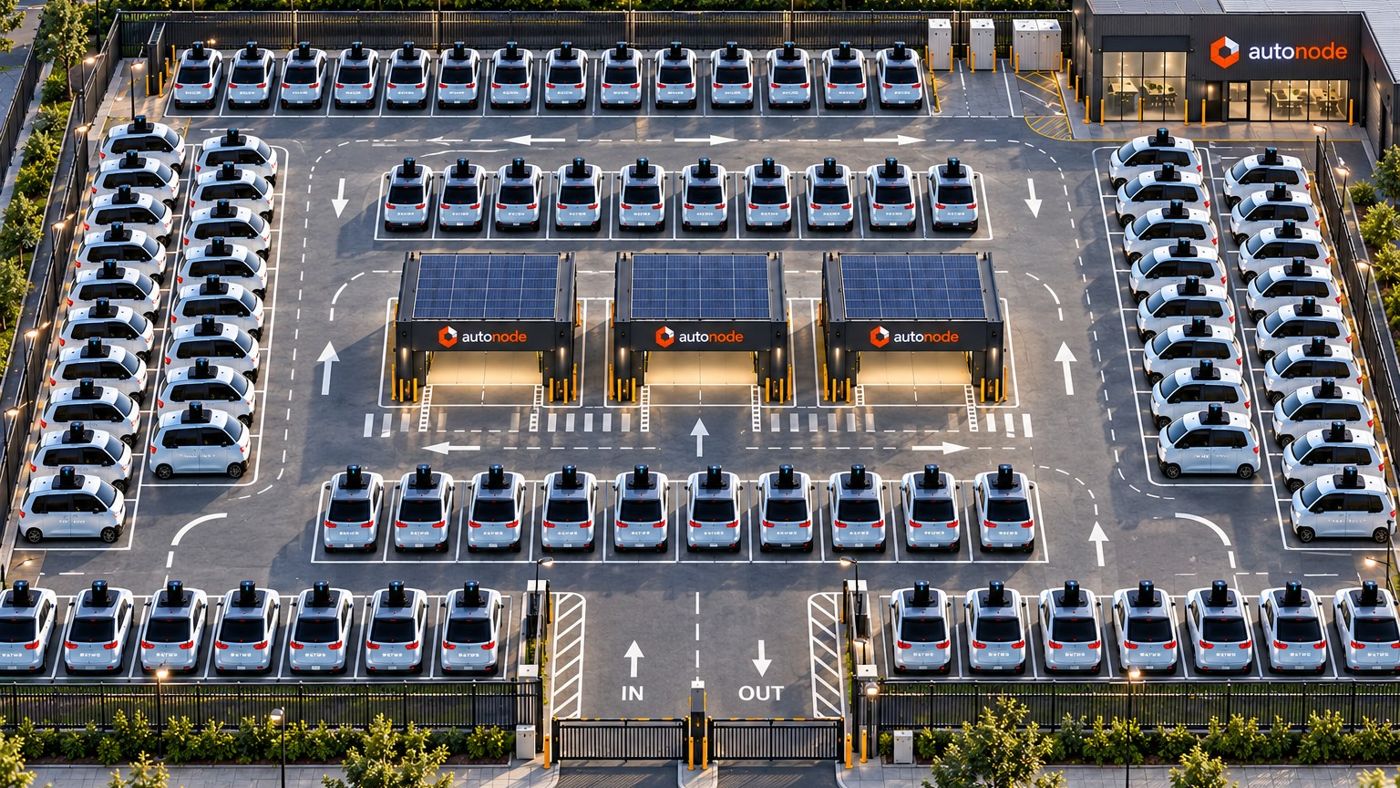
Many small pods, close to riders
We start on private sites with grid capacity. Kerbside pods come later, with city agreement.
- Fuel and charging forecourts
- Partners already have grid capacity and footfall.
- Fleet staging sites
- Pod clusters next to an operator’s staging lanes.
- Car parks and retail parks
- Surface or open top decks, with landlord agreement.
- Rail-station car parks
- Where autonomous cars meet trains.

Market
A €0.2–0.6bn yearly market by 2030
Yearly pit-stop spend in European and UK cities in 2030, by how many autonomous vehicles are on the road. Pit-stop fees plus energy margin, at two visits per vehicle per day.
Roll-out cities
- United KingdomLondon, 2027 pilot
- GermanyMunich, 2028
- SpainMadrid, 2029
- CroatiaZagreb, 2029
- NextFrance, Netherlands, Nordics
Pod economics
Stress-tested, not just optimistic
We model a cautious base case alongside our upside case. Fleets pay a fee per pit stop plus a monthly fee for reserved capacity, which makes revenue less dependent on volume.
Each extra visit keeps about 73% of its revenue after site rent and cleaning supplies. The first pilot pods cost more than pods at scale; they exist to prove the concept.
Working assumptions for discussion, not forecasts. Energy is passed through at cost, so only its margin counts as revenue.
| Measure | Base case | Upside case |
|---|---|---|
| Pit stops per day | 30 | 36 |
| Fee per pit stop | €14 + €2,500/month | €14 |
| Revenue | €191k | €204k |
| Running costs | €132k | €112k |
| Pod EBITDA (margin) | €59k (31%) | €92k (45%) |
| Capex per pod at scale | €355k | €300k |
| Simple payback | about 6 years | about 3.3 years |
| Break-even | 15 pit stops a day | 15 pit stops a day |
| Site share | Maintenance | Field service | Supplies | Grid charges | Remote ops | Insurance, data |
|---|---|---|---|---|---|---|
| 28.7 | 21.0 | 20.0 | 18.7 | 18.0 | 13.8 | 12.0 |
Roadmap
From a three-pod pilot to 600 pods
Autonomy inside the pod grows with each step: staffed on site in the pilot, supervised remotely at scale, hands-free for routine visits by 2031.
- 20273 pods
London pilot with a fleet partner. Staffed on site, with AI assisting.
- 202830 pods
London scale-up and Munich. Remote supervision.
- 2029120 pods
Four countries, including Spain and Croatia. Most visits hands-free.
- 2030–31300 → 600
Further European cities with site partners. Hands-free for routine visits.
Now · November 2026
Concept and economics
- Pod concept design
- Commercial model with three scenarios
- Talking to fleet operators and site owners
Dec 2026 – Feb 2027
Proof of concept
- Robotic plug-in bench demo
- Digital twin of a pod network
- Costed London pilot plan
Subject to selection in the Hitachi Startup Challenge FY26, which we are applying to.
2027
London pilot
- Three pods with a fleet partner
- Targets: 99% robotic plug-in success, 95% of damage spotted
Competition
Others automate one step. We run the whole pit stop.
The hardware is bought in on purpose. What is hard to copy is what we build around it: signed sites with grid power, software links into each fleet, and data from every visit.
| Company | In-city pods | Charging | Cleaning | Inspection | Europe and UK focus |
|---|---|---|---|---|---|
| Aseon Labs (US) | Yes | Yes | Yes | Yes | No, US first |
| Rocsys (NL) | No, depot robot | Robotic | Planned | No | Yes |
| Volterio (AT) | No, charging dock | Robotic dock | No | No | Yes |
| Zhida Technology (CN) | Charging-only sites | Robotic | No | No | Expanding |
| Wanxun Technology (CN) | Charging-only sites | Robotic | No | No | Not yet |
| RoboDock (US) | No, depot | Robotic | No | Yes | No |
| Autonode | Yes | Robotic | Yes | Yes | Yes |
Fleet operations companies that run depots today are customers, not rivals: Autonode automates their routine work.
Risks
What could go wrong, and what we do about it
Team
Built by people who know charging sites
The hardest part of this business is getting pods into the ground: sites, grid connections and chargers. That is where we start.
Sikai
Founder
Founder of Sea Horse Advisory, an independent consultancy in EV charging strategy, energy transition and competitive intelligence across UK and European markets.
We’re hiring
- Machine learning and robot learning lead
- Robotics and automation lead
- Fleet operations lead
- Grid and energy engineer
- Real-estate and site partnerships lead
Contact
Talk to the founder
Investors, fleet operators, site owners and future team members: we would like to hear from you.
hello@autonode-av.com